I have posted a page that covers the Colt Manual No. CM213 for the installation of the Colt 40mm M203 grenade launcher on the Swedish AK5 rifle.
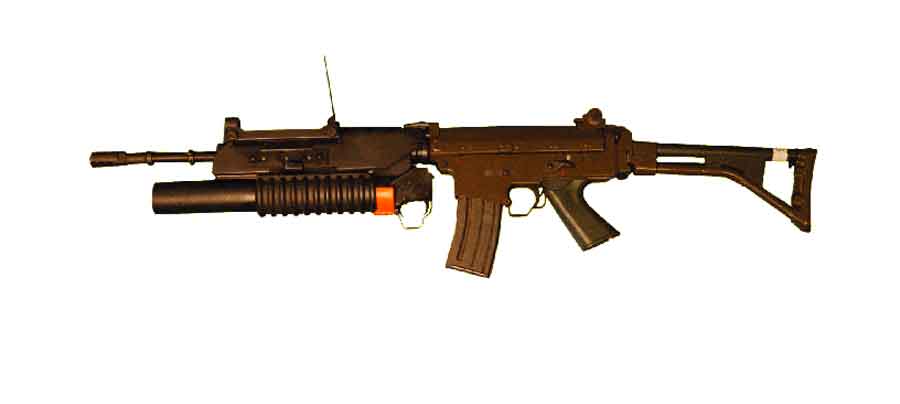
You can see the page at this link: https://thecoltar15resource.com/colt-l2040-ak5-m203-mounting-kit/
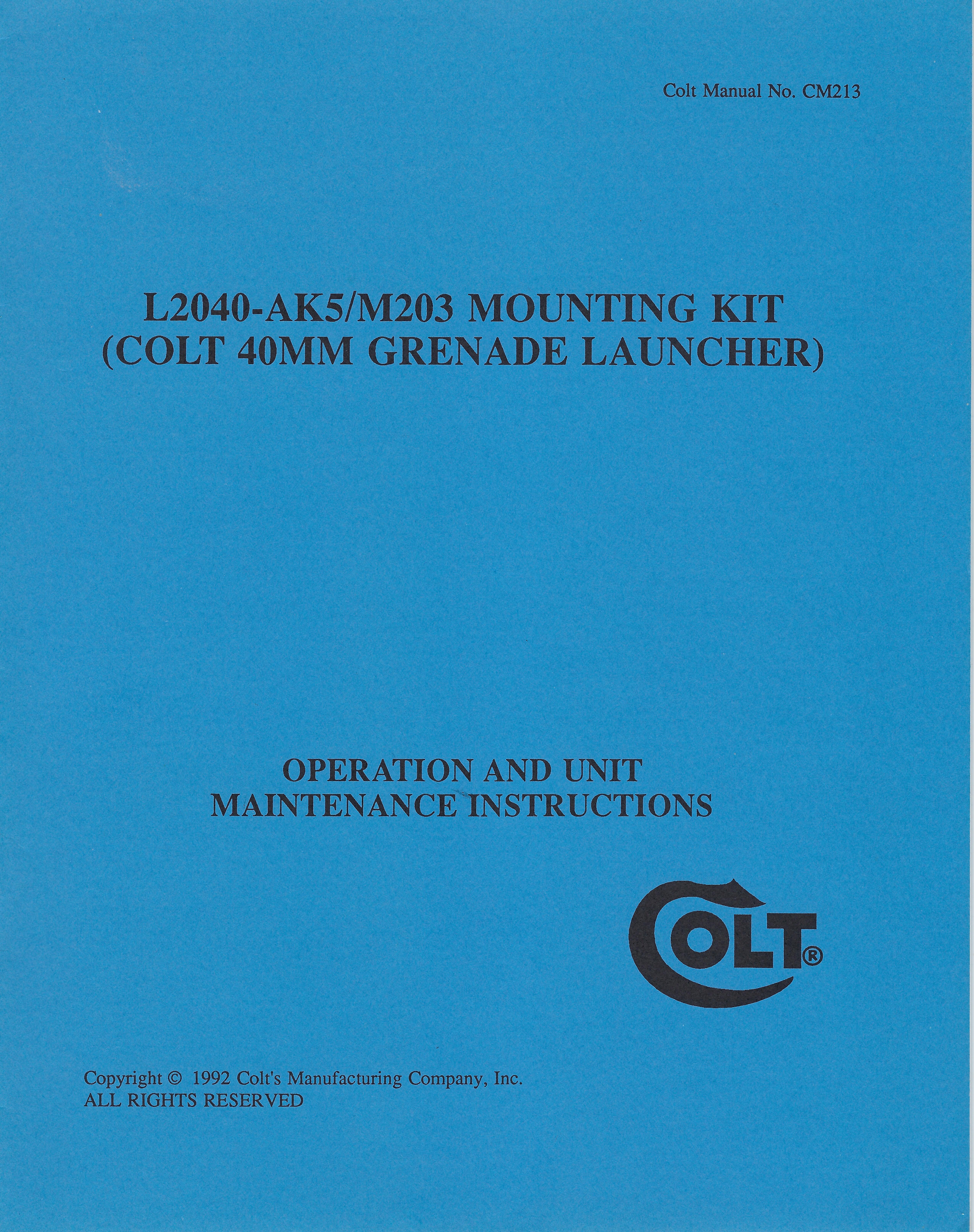

I have posted a page that covers the Colt Manual No. CM213 for the installation of the Colt 40mm M203 grenade launcher on the Swedish AK5 rifle.
You can see the page at this link: https://thecoltar15resource.com/colt-l2040-ak5-m203-mounting-kit/

Now available from Colt is the 7.62x39mm CR6762-EPR.

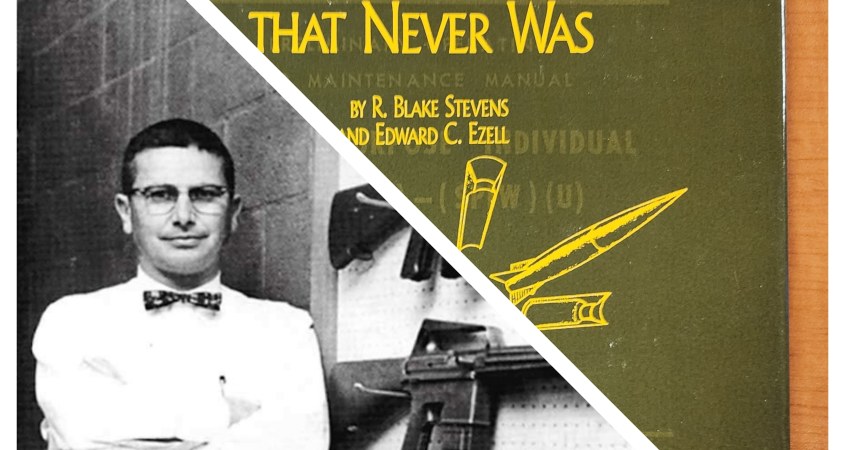
Over the coming weeks, you will see random posts talking about history leading up to the Colt AR-15. This is the first post in that series.
Eugene Stoner, the designer of the AR-15, was born in 1922. The seed of his historic firearm invention was planted in 1938 when the U.S. government established the Ballistic Research Laboratories at Aberdeen Proving Grounds.
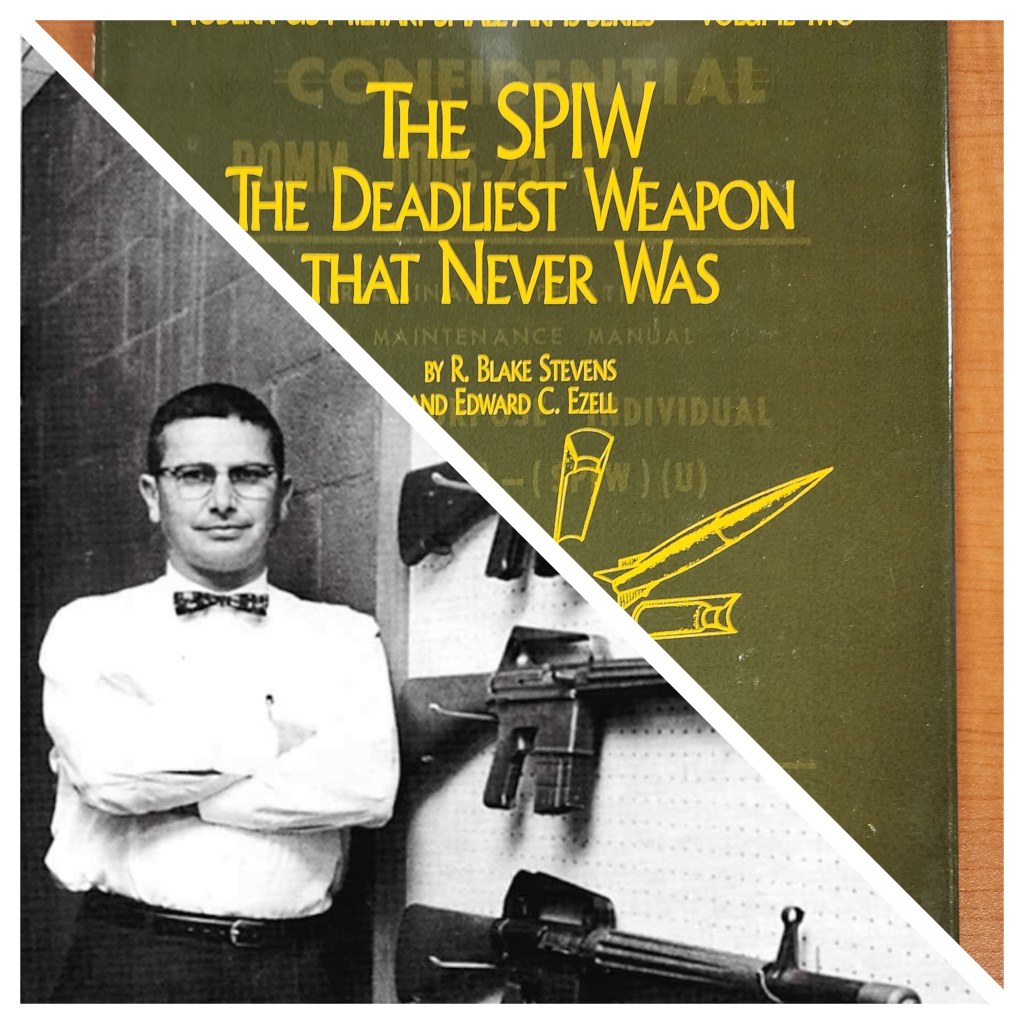
The purpose of the BRL was to conduct ballistics research for the Army. As a result of the enormous ammunition expenditure per enemy casualty (50,000 rounds fired per) in World War II, the Hall Report, titled “An Effectiveness Study of the Infantry Rifle” was published in 1952.
The Hall Report was significant because it became the document that formed the foundation of what became known as the “Small Caliber High Velocity” (SCHV) concept. The goal of the SCHV concept was to show that bullets around .22 caliber could produce lethality similar to the .30 caliber M2 projectile in use at the time.
The Hall Report was followed by the Hitchman Report which I will touch on in my next post.
Reference:
Stevens, R. B., & Ezell, E. C. (1985). The SPIW: The deadliest weapon that never was (Ser. Modern US Military Small Arms Series). Collector Grade Publications.
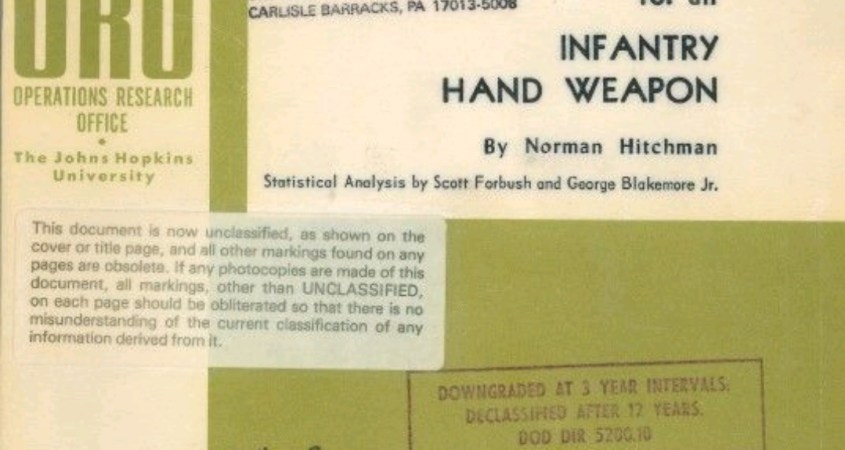
In my last post, I mentioned the Hall report that was published in March, 1952. The Hall report determined that a smaller projectile could perform better than the .30 caliber cartridge if it was fired at a higher muzzle velocity. The study additionally determined that “when the combined weight of the gun and ammunition is kept at 15 pounds, the overall expected number of kills for the .21 caliber rifle is approximately 2-1/2 times that of the present standard .30 caliber rifle.”
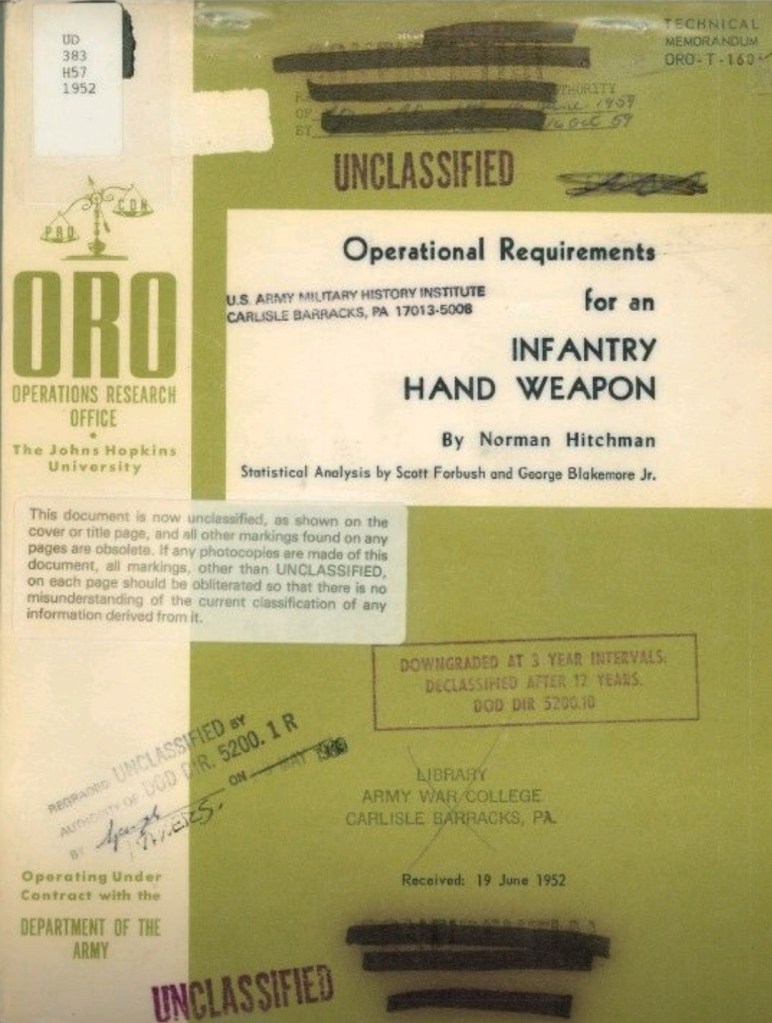
The publication of the Hitchman Report followed shortly after in June of 1952 and was formally titled “Operational Requirements for an Infantry Hand Weapon.” Discussed in the Hitchman Report was ‘Project BALANCE’ which looked at how often, and how much riflemen missed targets. This project also looked at distribution of hits at different ranges, wound effects and ballistic characteristics in combat.
The Hitchman Report embraced the concept that “it is desirable to increase both the number and rate of hits which may be inflicted on the enemy by aimed small arms in the hand of the infantry.”
In my next post, I will provide some interesting statistics from the Hitchman Report.
References:
Stevens, R. B., & Ezell, E. C. (1985). The SPIW: The deadliest weapon that never was (Ser. Modern US Military Small Arms Series). Collector Grade Publications.
Operations Research Office, & Hitchman, N., Operational Requirements for an Infantry Hand Weapon 1–124 (1952). Chevy Chase, MD; Operations Research Office.
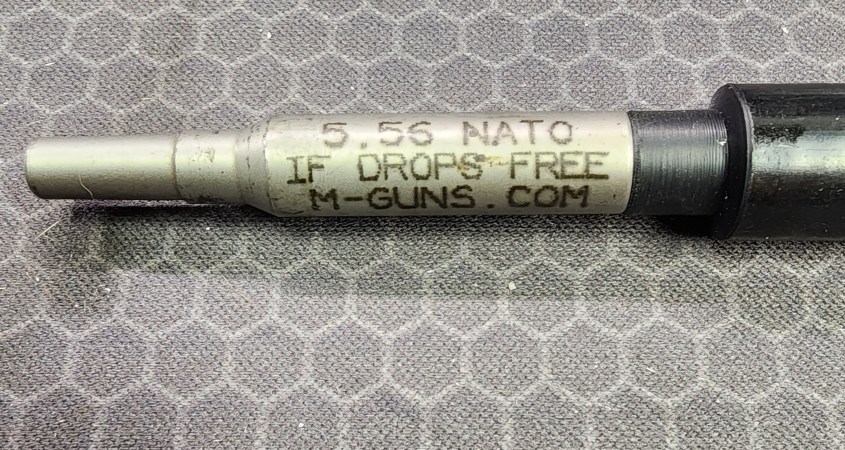
Many people are questioning whether or not the Colt CR6920-EC is really .223. In an effort to address the doubt and, to add another great tool to the tool box, I ordered a chamber gage from Ned Christensen/M-Guns.
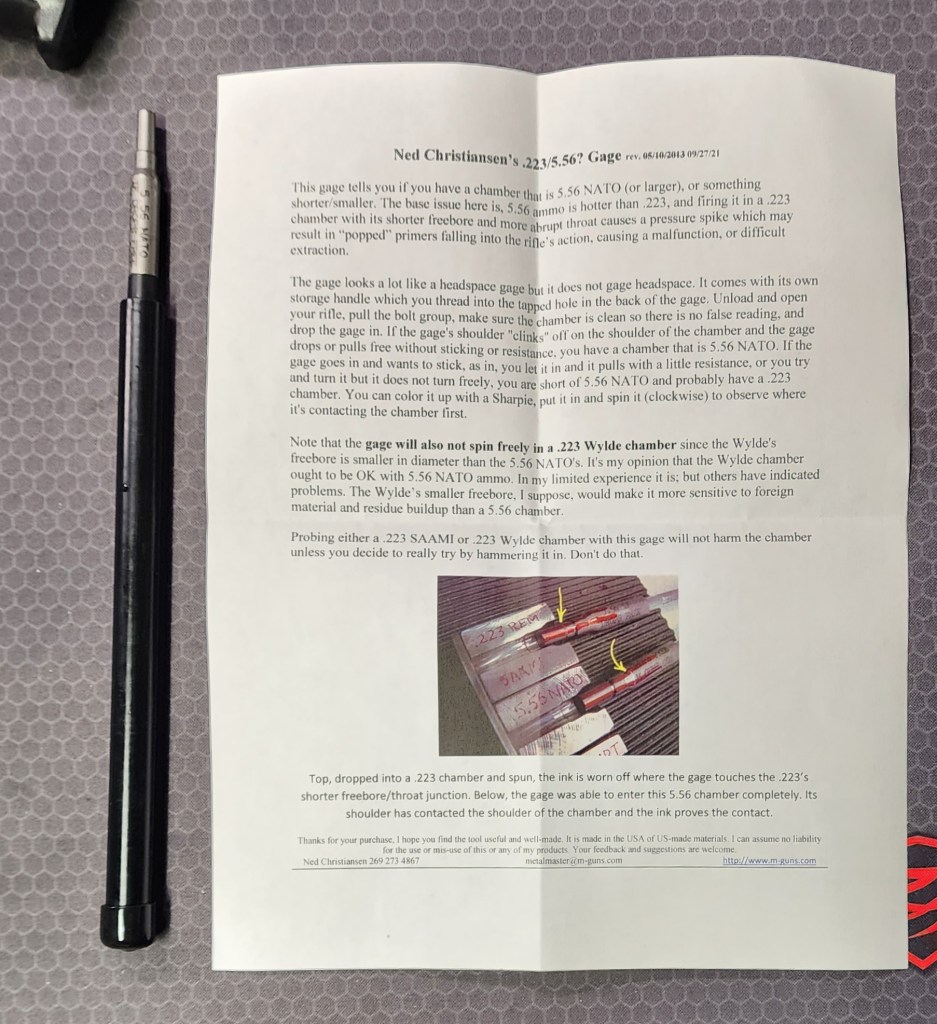
Above, is an image of the instruction sheet with the gage laying off to the left side of it.
The key take away from the instruction sheet is:
“drop the gage in. If the gage’s shoulder “clinks” off the shoulder of the chamber and the gage drops or pulls free without sticking or resistance, you have a chamber that is 5.56mm NATO.
If the gage goes in and wants to stick, as in, you let it in and it pulls with a little resistance, or you try to turn it but it doesn’t turn freely, you are short of 5.56 NATO and probably have a .223 chamber.”
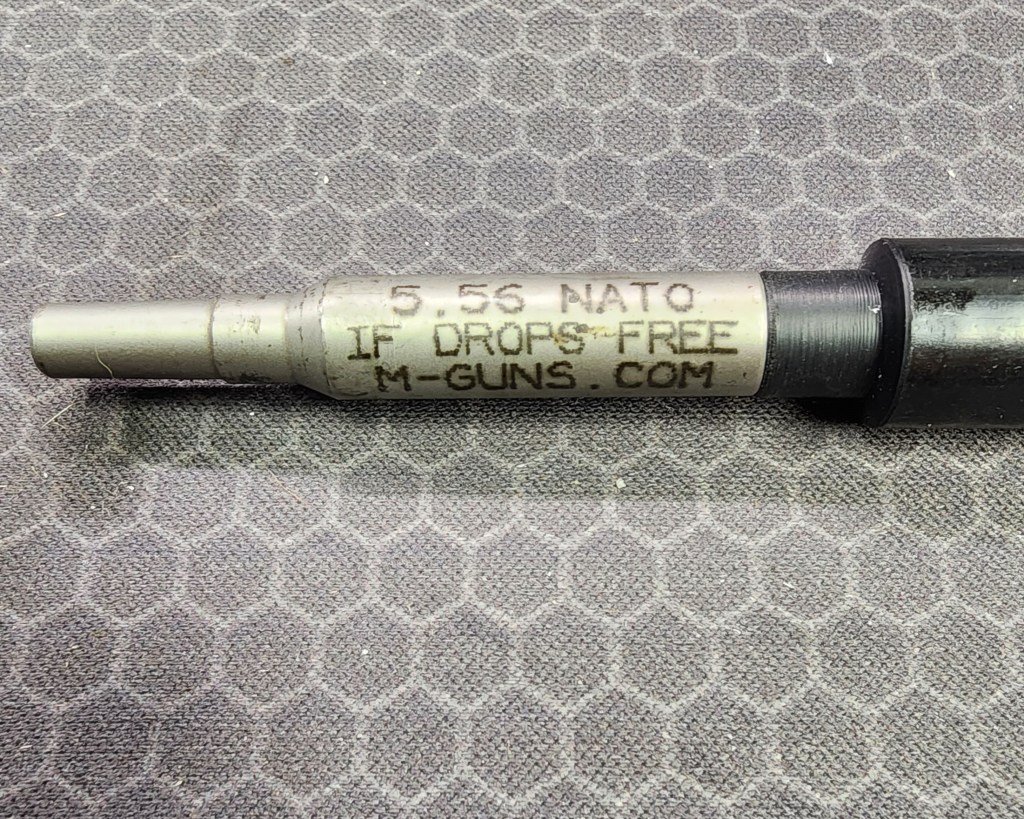
Here is the ‘business end’ of the gage.
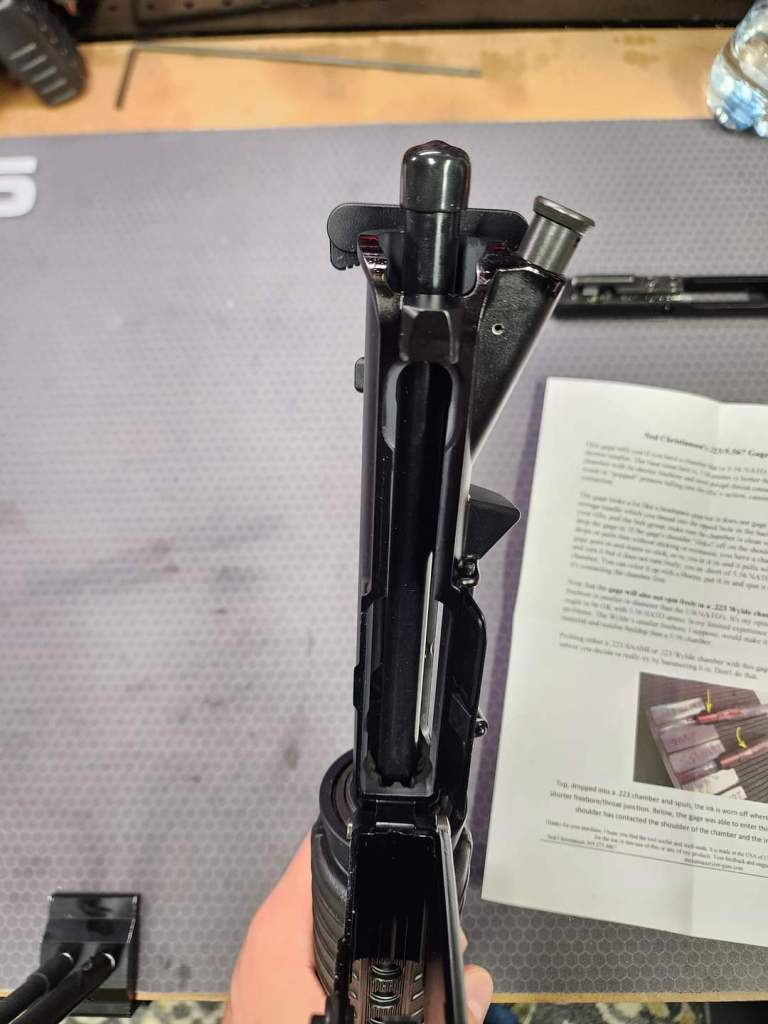
Here is a photo of the gage after being gravity dropped into the chamber.
The next photo shows the gage in the chamber despite being held upside down. This displays the gage having a tight fit and not dropping free.
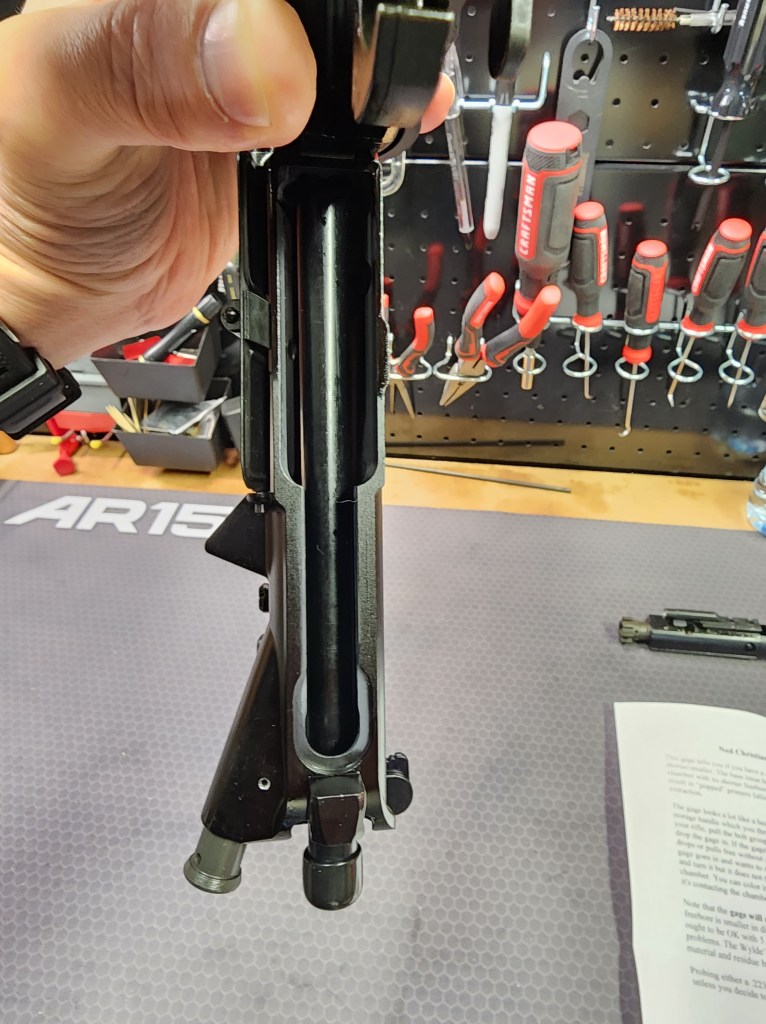
The reasonable assumption to draw from this is that the chamber is .223 since a 5.56mm specification gage fits tightly and does not drop free unaided.
Yes, you read that right. I know filling in manufacturer markings has been controversial in the firearms community for a long time. However, after messing around with it for a few minutes tonight, it sure would make manufacturer markings easier to see and photograph for my research/reference. Here, a grey crayola ‘twistable’ crayon was used to fill in the markings.
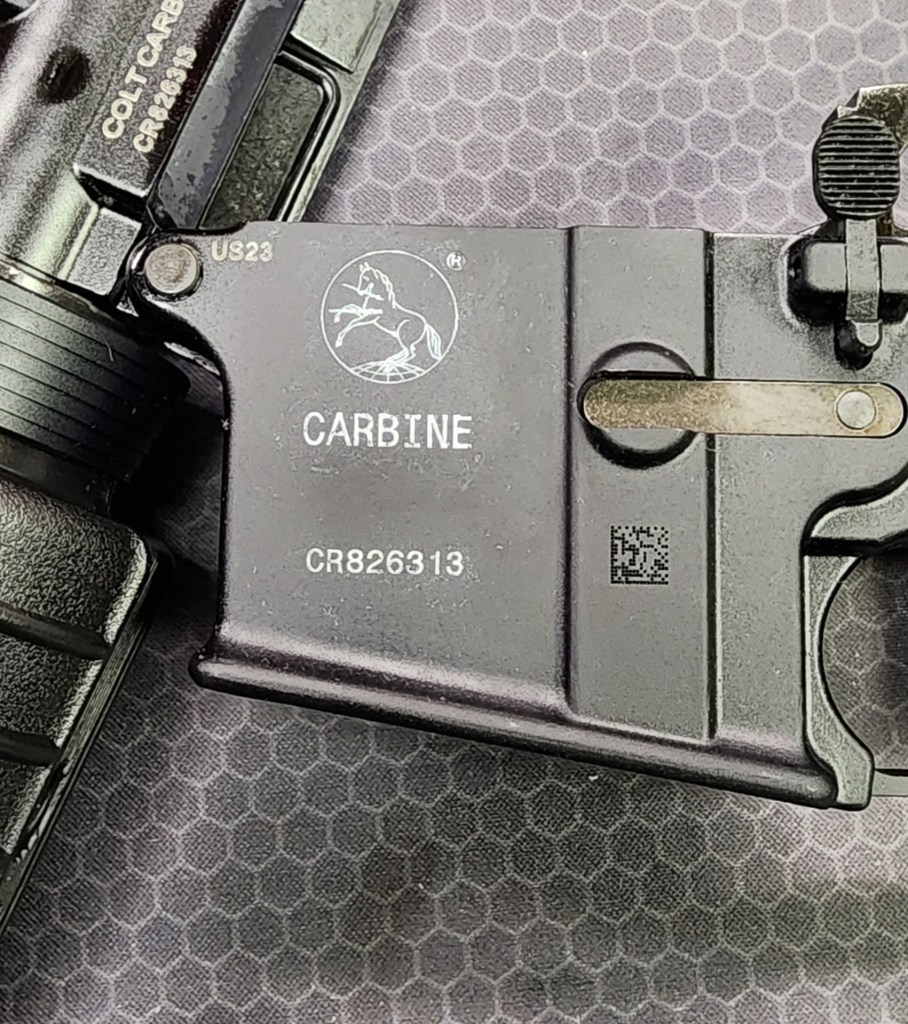
What do the visitors here think about this?
 The Colt AR-15 Resource