
In my last post, I mentioned the Hall report that was published in March, 1952. The Hall report determined that a smaller projectile could perform better than the .30 caliber cartridge if it was fired at a higher muzzle velocity. The study additionally determined that “when the combined weight of the gun and ammunition is kept at 15 pounds, the overall expected number of kills for the .21 caliber rifle is approximately 2-1/2 times that of the present standard .30 caliber rifle.”
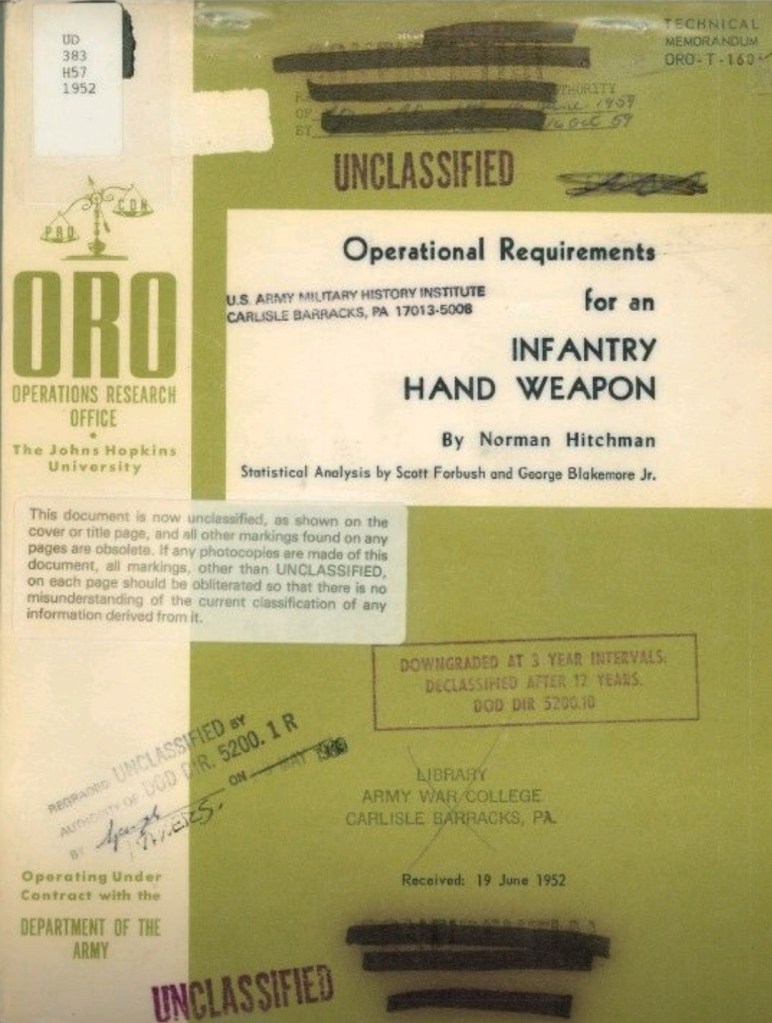
The publication of the Hitchman Report followed shortly after in June of 1952 and was formally titled “Operational Requirements for an Infantry Hand Weapon.” Discussed in the Hitchman Report was ‘Project BALANCE’ which looked at how often, and how much riflemen missed targets. This project also looked at distribution of hits at different ranges, wound effects and ballistic characteristics in combat.
The Hitchman Report embraced the concept that “it is desirable to increase both the number and rate of hits which may be inflicted on the enemy by aimed small arms in the hand of the infantry.”
In my next post, I will provide some interesting statistics from the Hitchman Report.
References:
Stevens, R. B., & Ezell, E. C. (1985). The SPIW: The deadliest weapon that never was (Ser. Modern US Military Small Arms Series). Collector Grade Publications.
Operations Research Office, & Hitchman, N., Operational Requirements for an Infantry Hand Weapon 1–124 (1952). Chevy Chase, MD; Operations Research Office.
 The Colt AR-15 Resource